


Key Takeaways
Great products do not sell themselves. Founders must learn to communicate value clearly.
Sell your product yourself before hiring a salesperson.
The first sales conversations teach you what customers care about, what they doubt, and why they buy.
A good sales pitch starts with the customer’s problem, not your product features.
Objections are not rejection. They are questions you have not answered clearly enough yet.
Follow up within 24 to 48 hours. Most founders lose deals by going quiet.
Negotiation protects your margins. Do not discount before you understand the trade.
Sales confidence comes from reps, feedback, and consistent action.
Why Founders Must Learn to Sell
Building a good product is not enough.
A founder must be able to explain the value, win trust, and close customers. Before you hire a sales team, you need to become your company’s first serious salesperson.
This matters even more in Kenya, where many founders are competing in crowded markets with similar products, similar prices, and similar promises. The founder who can sell clearly has an advantage.
Sales is not about becoming loud or pushy. It is about understanding the customer, naming the problem, showing why your product helps, and asking for the next step.
If you cannot sell the product yourself, hiring someone else usually creates expensive confusion. When they fail, you will not know whether the problem is the salesperson, the market, the pitch, or the product.
Founder-led sales gives you the truth faster.
Why Selling Your Own Product Matters

No one understands your product like you do.
You know why you built it, who it helps, and what problem it solves. That gives you an advantage no hired salesperson has on day one.
Every customer conversation teaches you something useful:
What words customers use.
What objections come up repeatedly.
What part of the pitch creates interest.
What makes people hesitate.
What finally makes them buy.
That feedback improves your product, your pricing, your positioning, and your business model.
A founder selling packaging supplies to a distributor in Naivasha does not need a perfect sales deck. They need a clear offer, a real conversation, and the ability to listen. That conversation either moves the business forward or it does not.
That is the work.
How to Start Selling Your Product
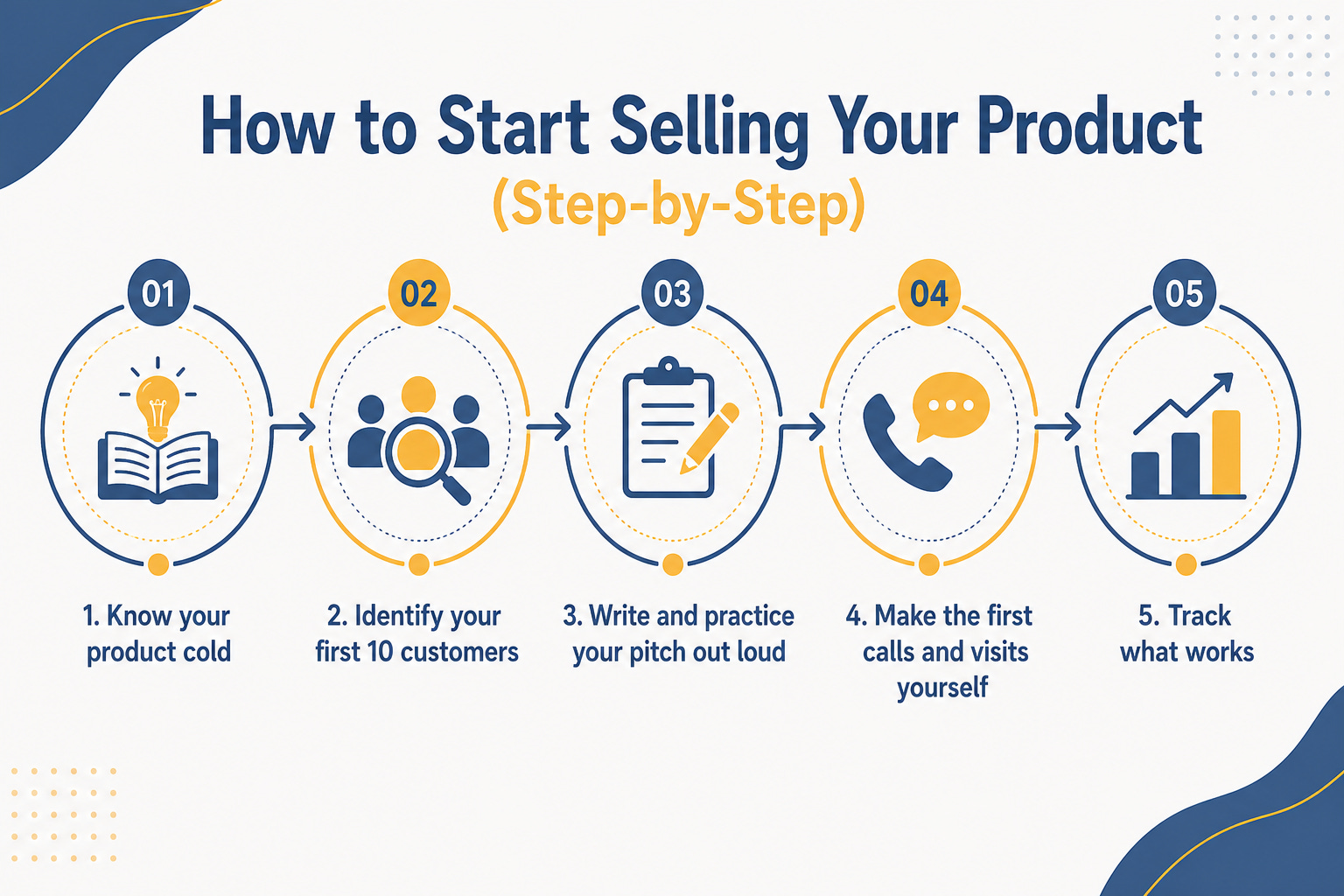
Start with five simple steps.
1. Know your product cold
Write one sentence that explains what your product does and who it is for.
If you cannot say it clearly, your customer will not understand it either.
Example:
“We supply reliable packaging materials to food businesses that need consistent quality and weekly delivery.”
Simple beats clever.
2. Identify your first 10 customers
Do not say “everyone in Nairobi.”
Be specific.
Better examples:
Salon owners in Eastlands who restock weekly.
Schools in Nakuru buying stationery in bulk.
Restaurants in Westlands that need consistent vegetable supply.
Small manufacturers that need packaging every month.
The narrower the list, the easier the approach.
3. Practice the pitch out loud
Say the pitch to a friend, another founder, or your mirror.
You will hear what sounds awkward. You will notice what is missing. You will find the sentence that actually lands.
Thinking about the pitch is not the same as saying it.
4. Make the first calls and visits yourself
Do the first 20 to 30 customer conversations yourself.
Every no teaches you something. Every confused look teaches you something. Every yes shows you what to repeat.
A hired salesperson will not bring back that learning with the same clarity.
5. Track what works
After each conversation, write down:
Who you spoke to.
What opening line worked.
Where they lost interest.
What objection came up.
What next step was agreed.
You are not just making sales calls. You are building a sales system.
How to Pitch With Confidence

A strong pitch has four parts:
The customer’s problem.
Your solution.
One piece of proof.
One clear next step.
Most founders start with features.
“Our lantern lasts 12 hours.”
“Our software has dashboards.”
“Our flour is fortified.”
That is not where the customer starts. The customer starts with their own problem.
A better opening is:
“How much are you currently spending on kerosene each week?”
“What happens when your supplier delivers late?”
“How are you tracking stock across your branches?”
Good sales starts with the customer feeling understood.
Once the problem is clear, explain your product in one or two sentences. Then add proof: a customer result, testimonial, trial, sample, or before-and-after comparison.
End with a specific next step.
Do not say:
“Let me know if you are interested.”
Say:
“Can I drop off a sample on Thursday?”
“Can we test this with one branch next week?”
“Can I send you a quote today and follow up tomorrow?”
Confidence comes from repetition. Your 50th pitch will be better than your first. Start before you feel ready.
How to Handle Customer Objections

Objections are questions in disguise.
When a customer says, “It is too expensive,” they may really be asking:
“Is this worth more than what I already use?”
When they say, “I need to think about it,” they may mean:
“I am not convinced yet.”
When they say, “We already have a supplier,” they may mean:
“I do not want the risk of switching.”
Your job is not to argue. Your job is to understand the real concern.
Common objections and better responses
“It is too expensive.”
Ask:
“What are you currently using, and what does it cost you?”
Then compare value, not just price.
“I need to think about it.”
Ask:
“Is there a specific concern I can help clarify now?”
This turns vague hesitation into a real conversation.
“We already have a supplier.”
Ask:
“What would need to be different for you to consider testing another supplier, even for one product?”
You are not asking them to switch everything. You are opening a door.
A founder selling cleaning supplies to a hotel should not walk away after hearing, “We already have a supplier.” They can request a trial for one product line. One product can start the relationship.
How to Follow Up Properly

Follow up within 24 to 48 hours.
Many founders lose deals because they go silent. The customer did not say no. The founder just disappeared.
Good follow-up is short, specific, and useful.
Reference the conversation. Add one useful thing. Ask for one next step.
Example WhatsApp message:
“Hi [Name], following up on our conversation about [product]. I’ve attached a quick overview and one customer example. I can drop off a sample this week. Would Thursday or Friday work better?”
That is enough.
No long paragraphs. No “just checking in.” No desperate energy. Tiny sales goblin, be gone.
Basic Negotiation Skills Every Founder Should Know

Selling creates interest.
Negotiation agrees on the terms.
By the time you are negotiating, the customer usually wants what you offer. Now you are discussing price, payment terms, volume, delivery, or timing.
This is where many founders lose money.
They discount too quickly. They accept bad payment terms. They agree under pressure because they want the deal.
Use three rules.
1. Know your walk-away number
Decide the lowest price or worst terms you can accept before the conversation starts.
Do not calculate this while the customer is pressuring you.
2. Let the customer speak first when possible
Ask:
“What budget are you working with?”
“What volume are you considering?”
“What terms do you usually work with?”
Their answer gives you information.
3. Trade, do not just discount
Do not drop price for nothing.
Instead say:
“I can offer that price if you commit to a three-month order.”
“I can extend payment terms after the first two successful orders.”
“I can include delivery if the order reaches this volume.”
A retailer may ask for 30-day credit when your cash flow cannot handle it. Do not say yes too quickly.
Say:
“For the first order, we can do 14 days. Once we have worked together for 60 days, we can review longer terms.”
That protects both sides.
How Kuzana Helps Founders Sell With Confidence
Kuzana helps founders build confidence in sales through practice, coaching, peer feedback, and real business accountability.
Most sales training is built for corporate teams. Kuzana is built for founders selling in Kenyan markets, where the founder is often still the best salesperson in the business.
Inside the 12-month program, founders practice their pitches, review customer conversations, sharpen their offers, and get honest feedback from people who understand what it takes to sell in the real world.
The goal is not to make founders dependent on themselves forever.
The goal is to help them understand sales well enough to build a real sales function later.
A founder who has sold the product can properly train a salesperson. They can spot weak performance. They can tell whether the problem is the salesperson, the pitch, the customer, or the offer.
A founder who has never sold is guessing.
Sales Confidence Is Built
No founder starts out fully comfortable selling.
The confidence comes from doing the reps.
Start with 10 customers. Practice the pitch. Ask better questions. Follow up within 48 hours. Learn to negotiate without giving away your margin.
Then repeat.
If you want to build this inside a structured program with coaching, capital, and a serious founder community, apply to Kuzana’s 12-month program.
Build the sales skill before you try to build the sales team.
FAQs
Can sales be self-taught?
Yes. Most founders learn sales by doing it. Formal training can help, but practice, feedback, and tracking results matter more.
How long does it take to become comfortable with sales?
Most founders improve after 20 to 30 real customer conversations. It usually starts feeling more natural after several weeks of active selling.
Should I hire a salesperson early?
Sell the product yourself first. Until you have personally closed customers, you do not know which pitch works, what objections come up, or what kind of salesperson you need.
What is the difference between selling and negotiating?
Selling creates interest. Negotiation agrees on the terms: price, payment, volume, delivery, and timing. Founders need both skills.
What should I do after a customer says no?
Ask what made them say no, write it down, and look for patterns. One no is feedback. Ten similar nos are data.