

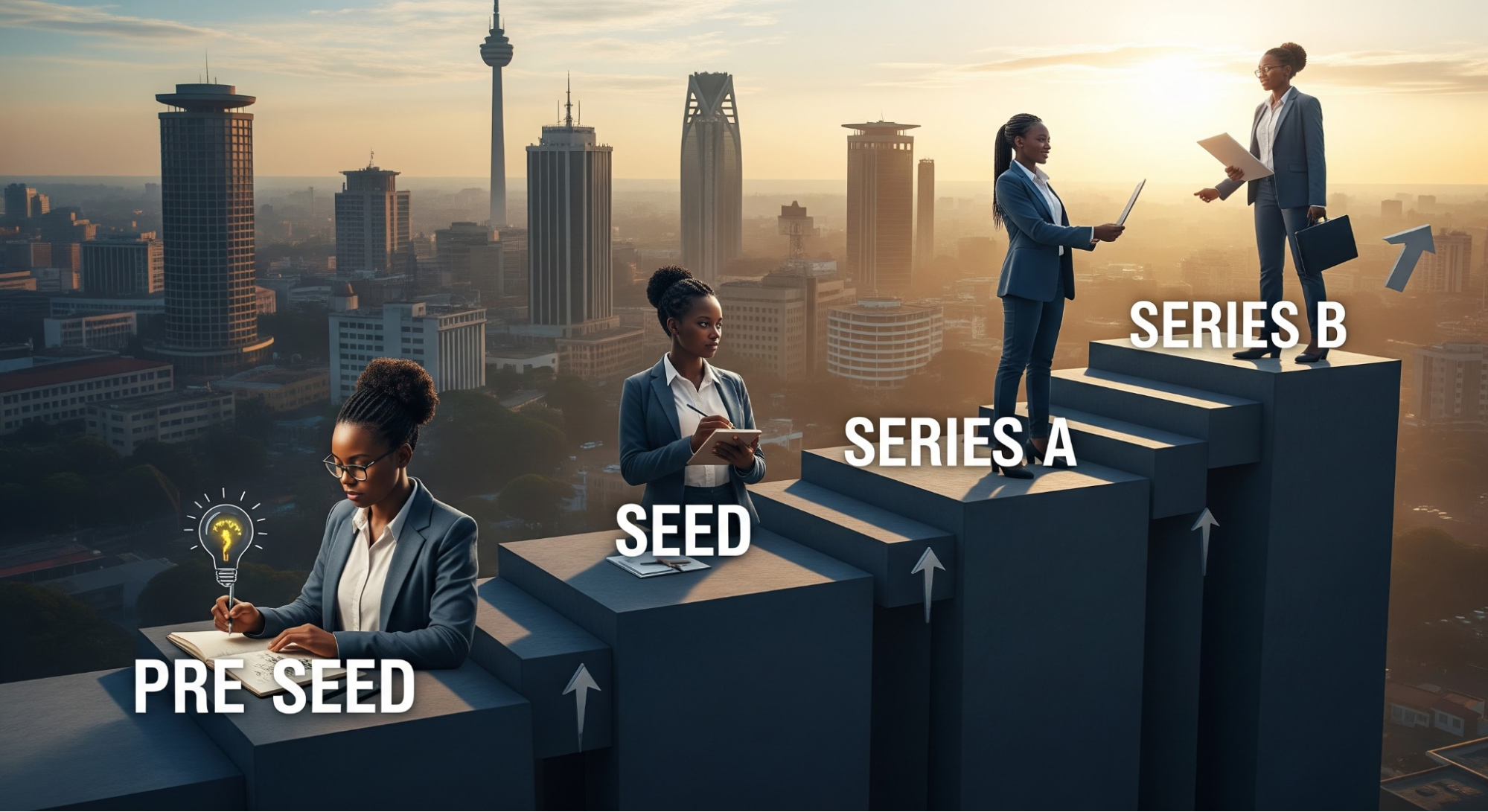
Key Takeaways
Kenya startup funding is not really about pitch decks. It is about becoming fundable.
Most founders are not rejected because their ideas are bad. They are rejected because the business is too early, too messy, too dependent on the founder, or not clear enough on how money turns into growth.
Each funding stage has different expectations. Pre-seed investors back the founder. Seed investors want paying customers. Bridge and Pre-Series A investors want systems, clean numbers, and repeatable growth. Series A and B investors want leadership depth, strong unit economics, audited books, and a credible scale story.
The best investor you will ever have is your customer. Before raising money, founders should ask whether they can make the product better, charge more, get customers to pay upfront, retain more customers, or cut unprofitable customers.
A fundable business is built on three things: community, focus, and professionalization. Community gives you access to customers, talent, advice, and warm investor introductions. Focus helps you cut what is not making money. Professionalization turns founder hustle into a company that can survive diligence.
Clean accounting, separate business and personal finances, signed contracts, a correct cap table, documented processes, and reliable tools are not “admin.” They are the foundation of investability.
If your business cannot run when you are not in the room, you are not yet building a company. You are still the operating system.
Funding is not the prize. Building a great business is the prize. Funding is one tool that serious businesses can use when they are ready.
What Are the Stages of Kenya Startup Funding?
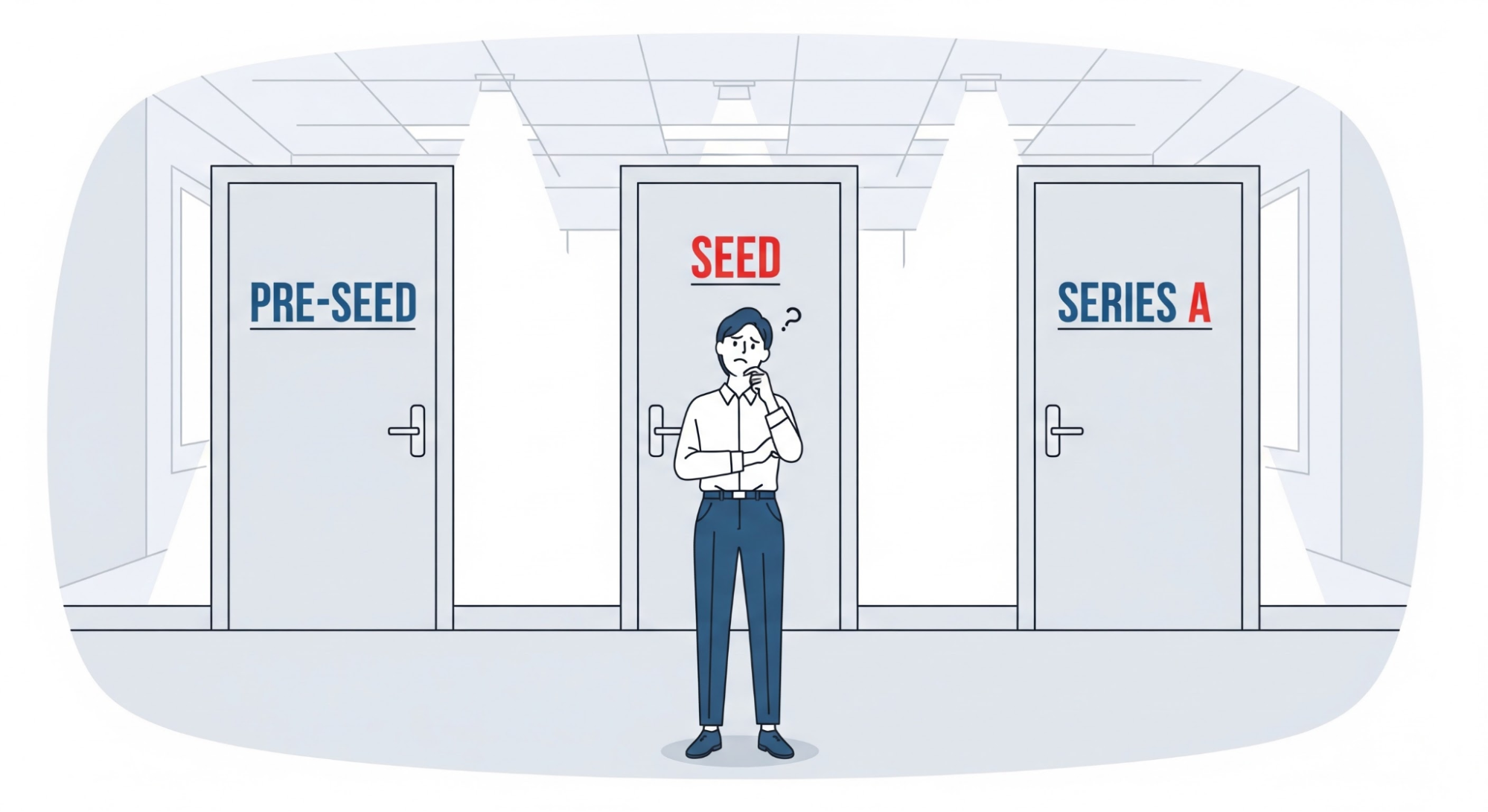
Most founders ask the wrong question.
They ask, “How do I raise money?”
The better question is, “What kind of business do I need to become before the right money will make sense?”
That shift matters because startup funding in Kenya is not one thing. A pre-seed grant, an angel cheque, working capital, revenue-based financing, a Series A equity round, and a Series B growth round are completely different tools. Each one suits a different kind of business.
When founders misunderstand their stage, they waste months. They pitch investors who cannot fund them. They build beautiful decks for businesses that still have no proof. They chase VCs when they should be chasing customers. They raise the wrong money, from the wrong people, at the wrong time, then wonder why the deal fell apart.
The hard truth: most businesses are not investment-ready because they lack basic operating discipline.
Not because the pitch deck is ugly.
Not because the market opportunity slide needs more icons.
Not because the financial projection model does not have enough tabs.
Investors are looking for evidence that the founder can handle more responsibility. More money means more accountability. If the business is already messy before investment, outside capital usually makes the mess bigger.
This guide explains the stages of Kenya startup funding from Pre-Seed to Series B. But more importantly, it explains what founders need to build at each stage to become fundable.
First Principle: Funding Is Not the Goal. Becoming Fundable Is the Goal.
A lot of founders think investment readiness means having three things:
A pitch deck
Financial projections
A big dream
Those help, but they are not the real test.
The real test is whether your business can responsibly use capital to grow.
That means you can answer basic questions quickly:
How much revenue did you make last month?
What was your gross margin?
Which product or sales channel makes the most money?
How many customers came back?
What exactly will you spend the money on?
What happens to the business if you are offline for two days?
Are your contracts signed and stored properly?
Are business and personal finances separate?
Does your second-in-command understand the company’s dream?
These questions sound simple. That is the point.
A serious investor is not only buying into your opportunity. They are buying into your judgment, discipline, trustworthiness, and ability to build a company that does not collapse under pressure.
So before you ask, “Which investor should I pitch?” ask, “What would make a good investor trust me with their money?”
Stage 1: Pre-Seed
Typical revenue: Ksh 0 to Ksh 400k per month
Pre-seed is the stage where you are proving that the business deserves to exist.
At this point, investors are mostly betting on the founder. They want to see domain knowledge, personal drive, speed of learning, and early signs that customers care.
This is not the stage to spend three months polishing a pitch deck. Spend those three months getting 20 paying customers.
That is your pitch.
What matters most at pre-seed
At pre-seed, the founder is the product. Investors and supporters are asking:
Are you trustworthy?
Are you close to the customer?
Can you learn fast?
Can you sell?
Can you take feedback without getting defensive?
Are you solving a real problem or chasing a nice idea?
The fastest way to answer those questions is not with projections. It is with customer evidence.
Who paid?
Why did they pay?
Did they come back?
What did you learn?
What changed because of that learning?
Where pre-seed founders can raise
Pre-seed funding in Kenya often comes from:
Personal savings
Chama contributions
Friends and family, with written agreements
Government programs such as Hustler Fund, Youth Enterprise Development Fund, Women Enterprise Fund, and innovation awards
Incubators and founder programs
Small grants
But the best funding source at this stage is still the customer.
Most companies do not need investment yet. They need to make the product more compelling, charge properly, get customers to pay upfront, and stop serving customers who destroy margins.
The Kuzana view on pre-seed
Pre-seed is not about pretending to be bigger than you are. It is about proving you are serious.
Serious founders do not hide behind “we are still early.” They test, sell, learn, and improve. They know the customer by name. They can explain the problem in one sentence. They are not too proud to ask for help.
That kind of founder is rare. And rare is fundable.
Stage 2: Seed
Typical revenue: Ksh 400k to Ksh 5m per month
Seed is where the business starts to show real traction.
People are paying. The model is beginning to work. The founder has evidence that the business can grow, but probably not enough systems yet to scale cleanly.
This is where many founders get overexcited. Revenue is growing, so they assume they are ready for serious investors. But seed investors are not only looking for growth. They are looking for the early signs of repeatability.
What seed investors want to see
At seed stage, investors want evidence that:
Revenue is consistent, not random
Customers are retained, not constantly replaced
Gross margins make sense
The founder understands the numbers
The business can grow without depending entirely on founder heroics
The team has started taking ownership
The use of funds is clear and specific
A founder who says, “I need Ksh 10m for growth” is not ready.
A founder who says, “I need Ksh 10m to buy this machine, here is the quote, import duty, transport cost, installation cost, 10% contingency, expected output, expected margin improvement, and payback period” is having a different conversation.
One is asking for money.
The other is showing judgment.
Where seed founders can raise
Seed funding in Kenya may come from:
Angel networks such as NaiBAN, VBAN, Rising Tide Africa, and Lokal Capital
Accelerators that combine capital with operational support, like Kuzana
Impact investors in sectors such as agri, climate, logistics, and health
Convertible notes
Strategic angels
Early-stage funds
Revenue-based financing, depending on the business model
Typical seed rounds may range from Ksh 5m to Ksh 50m, depending on the business, sector, growth, and investor type.
What seed founders must professionalize
Seed is where founder hustle must start becoming company infrastructure.
That means:
Separate personal and business bank accounts
Pay the founder a salary, even if modest
Keep correct monthly accounts
Track revenue by category, not one lazy “sales” line
Record inventory properly
Keep signed employment contracts
Store documents in a central Google Drive
Use a reliable business email
Keep a clean calendar
Track customer retention
Know your best sales channel
Delegate at least part of sales or operations
This is not bureaucracy. This is how you stop being the bottleneck.
Until a founder can delegate, they are not really a CEO. They are the person everyone calls when the tap leaks, the customer complains, the driver is lost, the accountant is confused, and the sales phone rings during an investor meeting.
That is not leadership. That is expensive chaos wearing a founder hoodie.
Stage 3: Bridge or Pre-Series A
Typical revenue: Ksh 5m to Ksh 20m per month
Bridge or Pre-Series A is the stage where many promising Kenyan businesses get stuck.
They are too advanced for seed, but not ready for Series A. They have revenue, customers, and ambition. But they do not yet have the systems, reporting, leadership team, or clean financial history that institutional investors require.
This is the stage where the gap between a good business and a fundable business becomes painful.
Why founders stall here
Founders often stall at this stage because:
Books are kept in a messy spreadsheet
The CEO cannot explain revenue and profit without calling the accountant
Business and personal expenses are mixed
The cap table is wrong or politically convenient
Contracts are missing or unsigned
Inventory records are inaccurate
No one tracks customer retention
The founder still makes every important decision
The team is scared to give honest feedback
The company has no SOPs or checklists
The founder cannot explain which part of the business actually makes money
This is also where lack of focus becomes expensive.
Focus means cutting off the pet projects you love if they do not make money. It means choosing the product, customer segment, and sales channel that actually drive profit. It means admitting that ambition without discipline is just noise in a nice shirt.
What Bridge or Pre-Series A money should be used for
At this stage, capital should usually help the company become more durable.
Good uses of money include:
Hiring a real finance person
Cleaning up accounting
Auditing financials
Building sales systems
Creating SOPs and playbooks
Improving inventory controls
Strengthening the leadership team
Investing in reliable tools, internet, power backup, and software
Building dashboards for key metrics
Funding working capital tied to confirmed demand
Bad uses of money include:
Founder salary jumps before the company is profitable
Random expansion before the home market is working
Marketing spend without channel ROI
New product lines that distract from the core business
Hiring people before roles are clear
Fancy offices to impress people who are not customers
Bridge capital should bridge you to fundability, not bridge you to a bigger mess.
Funding options at Bridge or Pre-Series A
Options may include:
Bridge rounds from existing investors
Revenue-based financing
Working capital lines
Development finance institutions
Strategic investors
Larger angel groups
Early growth investors
But before looking for any of these, founders need to know exactly what the money will do.
If the use of funds is vague, the business is not ready.
Stage 4: Series A
Typical revenue: Ksh 20m+ per month with consistent growth
Series A is not “seed but bigger.”
Series A means the company has enough proof that institutional investors can believe in a much larger outcome. At this stage, you are not just proving that customers will pay. You are proving that the business can scale with discipline.
Investors want a company, not a founder’s personal magic trick.
What Series A investors expect
Series A investors usually want to see:
2 to 3 years of clean financial history
Audited accounts
Strong unit economics
Clear gross margins
Customer retention data
CAC and LTV, where relevant
A leadership team beyond the founder
Documented processes
A credible path to Ksh 100m+ monthly revenue
A clean cap table
Compliance discipline
A clear use of funds
A strong exit story
This is where the CEO’s personal operating habits become company risk.
If the CEO misses meetings, cannot manage a calendar, communicates poorly, refuses diligence, or gets defensive under feedback, investors notice. They are not only evaluating the company. They are evaluating what life will be like after they invest.
Investment is a marriage.
More responsibility, more reporting, more pressure, more possibility.
If you do not want that marriage, do not raise equity. There are other ways to build.
The role of community at Series A
Cold outreach rarely works well at Series A.
By this stage, credibility matters. Warm introductions, customer references, investor references, advisors, existing backers, and sector relationships all matter.
This is where community becomes more than encouragement. It becomes access.
The best founders build their network long before they need money. They ask experienced people for advice. They learn from operators who have done it before. They stay visible through progress, not hype.
The strongest fundraising strategy is not begging strangers for a cheque. It is building a business that credible people are proud to introduce.
Stage 5: Series B
Typical revenue: Ksh 100m+ per month with a proven model and regional scale potential
Series B is not about proving the model works. That conversation is over.
This round is about scaling what already works into a much larger company. New markets. New product lines. Regional expansion. Deeper leadership. Stronger infrastructure. Category leadership.
At Series B, ambition must be matched by evidence.
What Series B investors expect
Series B investors want to see:
Consistent revenue growth over 24+ months
Strong margins
Low churn
Reliable retention data
A second-layer leadership team
Clean multi-year audited financials
Country-by-country expansion logic
Strong governance
A clear exit pathway
A company that can become a major regional player
What kills Series B deals?
Founder still making every day-to-day decision
Growth without margin improvement
Expanding before the home market is locked
Messy cap table from too many early investors
Weak reporting
No clear story for how this becomes a $100m+ revenue business
Series B investors are not funding hope. They are funding a machine.
If the machine only works when the founder personally pushes every lever, it is not ready.
Quick Self-Diagnostic: Which Stage Are You At?
Use this as a rough guide.
Your Current Situation
No revenue yet, still testing your business idea → Pre-Seed
Early revenue below Ksh 400,000 per month → Pre-Seed
Ksh 400,000 to Ksh 5 million per month with paying customers → Seed
Ksh 5 million to Ksh 20 million per month, growing steadily, but internal systems are still developing → Bridge / Pre-Series A
Ksh 20 million+ per month, with strong unit economics, clean financial records, and a developing leadership team → Series A
Ksh 100 million+ per month, a proven business model, and ready to scale across Kenya or other African markets → Series B
But revenue alone does not decide your stage.
A company doing Ksh 10m per month with poor books, mixed personal expenses, weak margins, and no customer retention data may still be less fundable than a company doing Ksh 3m per month with clean numbers, strong retention, and a focused growth plan.
Stage is not just size.
Stage is maturity.
The Real Investment Readiness Checklist
Before raising money, founders should pressure-test the business across five areas.
1. Character and trust
Investors are asking: “Can we trust this person with money?”
Red flags include:
Taking company money for personal expenses
Planning to double salary immediately after investment
Paying distributions before the company is sustainably profitable
Hiding debt
Misrepresenting the cap table
Treating diligence as an insult
Until the company is making healthy, reliable profit, founders should pay themselves enough to survive and stay focused, but not treat investment money like a personal upgrade plan.
You cannot make a good deal with a bad person. And you cannot build a great company on small dishonesties.
2. Focus
Focus means knowing what actually makes money.
That requires:
Revenue by product or category
Gross margin by product or category
Marketing ROI by channel
Customer retention by segment
Clear monthly KPIs
Courage to cut distractions
Most founders do not need more ideas. They need fewer, better-executed ideas.
If one product line makes money and three drain attention, focus is not a motivational quote. It is a knife.
Cut.
3. Professionalization
Professionalization means the business can survive scrutiny.
That includes:
Correct accounting for several months
Separate business and personal bank accounts
Business email, not personal email
Signed employee contracts
Centralized document storage
Password manager
E-signatures
Correct CR12 and cap table
Tax compliance
Loan schedules
Asset register
Inventory records
Playbooks and SOPs
Checklists for recurring work
This work is not glamorous. Neither is brushing your teeth. Still recommended.
Professionalization tells investors that the founder respects the business enough to make it legible.
4. Leadership and delegation
A founder who cannot delegate cannot scale.
At minimum, the founder should begin delegating parts of sales, operations, finance, or customer service. If staff taking sales calls could “steal all your clients,” then the business has a deeper problem. The company has not built trust, systems, or defensibility.
Investors also look at whether the team understands the dream.
Ask your second-in-command: “What is the big opportunity for this company?”
If they cannot answer, the founder may have a vision, but the company does not.
Then ask the founder: “What are this person’s professional and personal goals?”
If the founder does not know, they are missing one of the cheapest and most powerful ways to motivate people.
5. Communication and execution speed
Investors notice how founders operate.
Can you join meetings on time?
Do you keep a calendar?
Can you communicate concisely?
Do you respond to emails?
Can you find requested documents quickly?
Is your internet reliable?
Does your laptop work properly?
Can you use basic tools like Google Sheets, Google Drive, e-signatures, ChatGPT, and a password manager?
These may sound small, but they reveal whether the CEO is ready for the workload that comes with investment.
If raising capital doubles your reporting and communication burden, slow tools and messy habits become expensive.
Six Common Funding Mistakes Kenyan Founders Make

1. Pitching the wrong investor for your stage
Every investor has a mandate. Stage, sector, cheque size, geography, return expectations, and risk appetite all matter.
If you are at seed and pitching Series A funds, you are probably wasting time. Worse, you may become known as “not ready” before you are ready.
Do your homework.
2. Chasing investors instead of customers
The best investor is your customer.
Customers validate the problem, fund operations, improve your product, and give you leverage in investor conversations.
A business that does not desperately need investment is usually more attractive to investors.
Annoying, but true.
3. Raising before the business is professionalized
Investment due diligence exposes mess.
Missing contracts, poor accounting, weak compliance, mixed finances, and broken cap tables can kill a deal after months of effort.
Fix the basics before you enter the process.
4. Giving away too much equity too early
A messy cap table can make a good business uninvestable.
If the founder owns too little, or a passive early investor owns too much, future investors may walk away. They need the people building the company to have enough upside to keep building.
5. Using grants as a business model
Grants can be helpful. They are not a customer.
Use grants to reach a revenue milestone, build capacity, or test something specific. Do not use them to avoid proving that customers will pay.
6. Expanding before the core business works
Expansion feels exciting. It also multiplies problems.
If the home market is not working, a new county or country usually does not fix the business. It just exports confusion.
Earn the right to expand.
Active Kenya Investors by Stage
This is a rough guide, not a replacement for doing investor research.
Pre-Seed
Founder Institute Kenya
Antler Nairobi
iHub
NAILAB
GrowthAfrica
KeNIA Presidential Innovation Award
Hustler Fund
Youth Enterprise Development Fund
Seed
Kuzana, for founders around Ksh 400k to Ksh 20m monthly revenue who want equity investment, working capital access, business education, and operational systems
Nairobi Business Angel Network, NaiBAN
Viktoria Business Angels Network, VBAN
Lokal Capital
Rising Tide Africa
Safaricom Spark Fund
Google for Startups Accelerator Africa
500 Global and UNDP Sustainable Innovation Accelerator
Bridge or Pre-Series A
Existing investors
Revenue-based financing providers
Working capital lenders
Catalyst Fund
Equator
IFC
British International Investment
FMO
Proparco
Series A and Beyond
TLcom Capital
Novastar Ventures
Partech Africa
Savannah Fund
Chandaria Capital
54 Collective
British International Investment
IFC
Other pan-African and global emerging market investors
Again, the name of the investor matters less than the fit.
The right investor at the wrong stage is still the wrong investor.
The Bottom Line
Kenya’s startup funding ecosystem is real. Capital exists. Investors are looking. The opportunity is large.
But capital is not evenly spread, and it does not flow to every founder with a big dream.
It flows to founders who become believable.
Believable founders know their numbers. They keep clean books. They separate personal and business finances. They focus on what makes money. They retain customers. They build teams. They use modern tools. They ask for help. They create systems. They communicate clearly. They know exactly what they will do with the money.
That is what makes a business fundable.
Not a prettier pitch deck.
Not a bigger TAM slide.
Not saying “AI-enabled” three times and hoping everyone gets dizzy.
If you are doing Ksh 400k to Ksh 20m in monthly revenue, you probably do not need more fundraising theory. You need to professionalize the business so growth can stick.
That is what Kuzana was built for: community, focus, and professionalization for serious Kenyan entrepreneurs. Education, equity investment, working capital access, and operational systems that help every shilling work harder.
Funding is useful.
But becoming fundable is the real work.
Start there.
FAQs
What are the stages of startup funding in Kenya?
The main stages are Pre-Seed, Seed, Bridge or Pre-Series A, Series A, and Series B. Each stage reflects a different level of revenue, business maturity, systems, team depth, and investor expectation.
How much funding can Kenyan startups raise at each stage?
Pre-seed funding is usually small and may come from savings, grants, family, or early programs. Seed rounds may range from Ksh 5m to Ksh 50m. Bridge rounds vary widely depending on the company and funding type. Series A rounds are much larger and usually require strong revenue, audited books, unit economics, and a leadership team. Series B rounds are for companies with proven models ready to scale regionally.
What stage should my business be at for seed funding?
Seed funding usually makes sense once your business has paying customers, consistent monthly revenue, and early proof that the model works. For many Kenyan businesses, that may mean around Ksh 400k to Ksh 5m in monthly revenue, though investor expectations vary by sector.
When is early-stage funding available in Kenya?
Early-stage funding becomes more realistic when you have customer evidence. Pre-seed support may be available before revenue, but stronger seed funding usually requires paying customers, revenue growth, and a clear plan for how capital will improve the business.
Which investors fund Kenyan startups at seed stage?
Seed-stage capital may come from angel networks, accelerators, impact investors, early-stage funds, strategic angels, and operators with sector experience. Examples include NaiBAN, VBAN, Rising Tide Africa, Lokal Capital, Safaricom Spark Fund, Google for Startups Accelerator Africa, and Kuzana, depending on the company’s stage and fit.
Do I need a pitch deck to raise investment?
A pitch deck helps, but it is not the main thing. Investors care more about whether the business is fundable: real customers, clean books, focused growth, strong margins, trustworthy founders, clear use of funds, and a company that can operate without everything depending on the CEO.
What makes a Kenyan business investment-ready?
An investment-ready business has paying customers, clean accounting, separate personal and business finances, signed contracts, correct compliance, a clear cap table, strong retention, basic systems, a focused growth plan, and a founder who can explain the numbers without hiding behind the accountant.
What is the best source of funding for an early-stage business?
The best early source of funding is often the customer. Before raising from investors, founders should look for ways to improve the product, charge correctly, get upfront payments, retain customers, and cut unprofitable work. A business funded by customers has more leverage when speaking to investors.